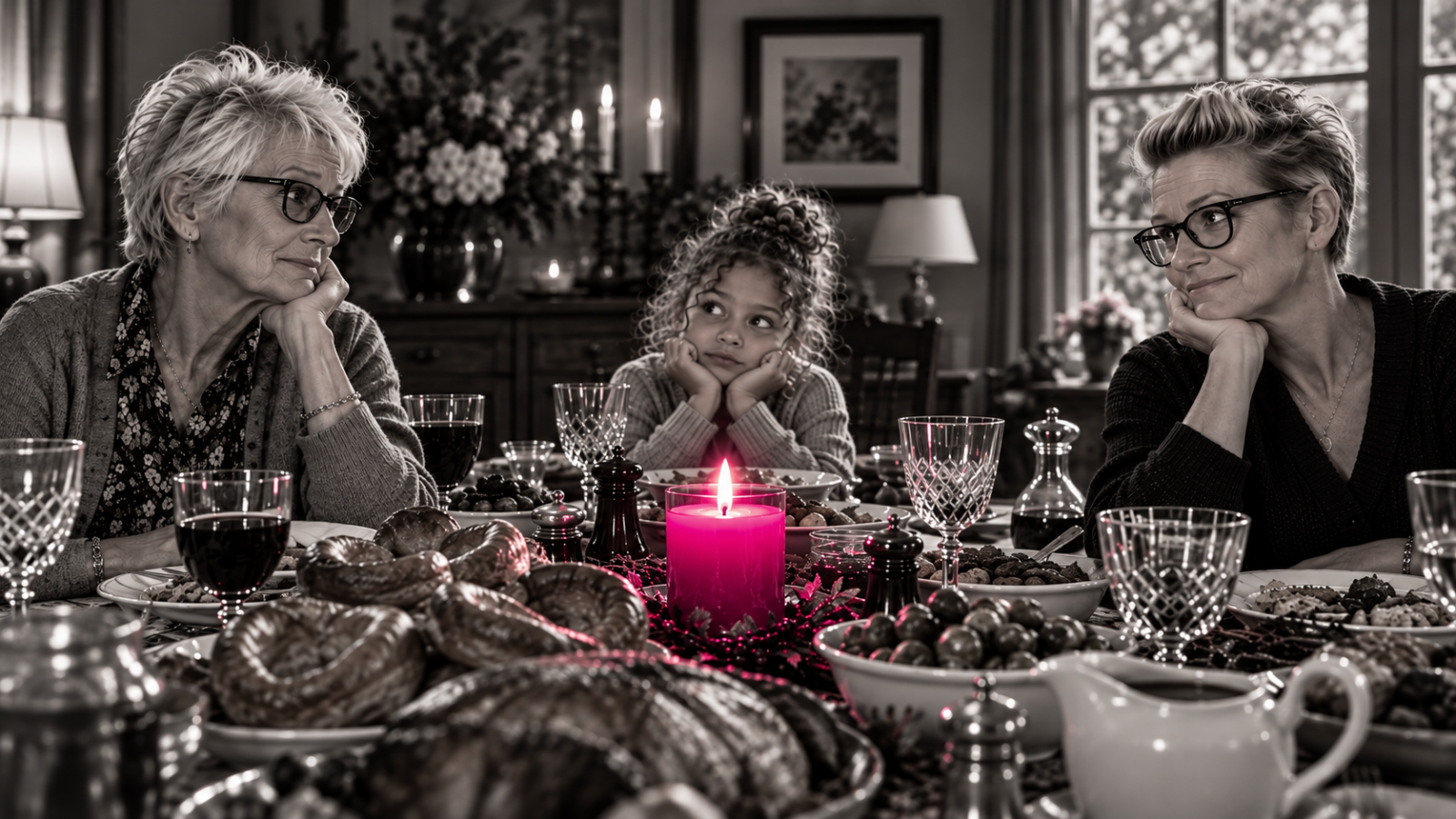
An intimate study of family expectations, inherited guilt and the extraordinary things we say without opening our mouths.
Of all the birds that nest in the British Isles, few are as widely distributed, or as poorly understood, as the common family. It can be found in every town and village in the country, it is rarely seen outside its own territory except at Christmas, weddings and funerals, and it is most easily observed on a Sunday at around one o’clock, when the scattered members of the flock return to the original nest to feed.
Birdwatchers will know it by its best clothes, its elaborate rituals around the gravy, and its long, loaded silences. What brings the flock home, week after week, is the same thing it has been chasing since it hatched: parental approval. What follows is the result of many years spent watching it from a discreet distance, with a camera crew, a pair of binoculars and a flask.
The Habitat
Here, in the warm and slightly overheated habitat of the family home, two generations of the same species gather around the Sunday roast, in a ritual that has survived two world wars, several recessions and the arrival of the air fryer. To the untrained eye, it looks like lunch. To anyone who has watched the species for long enough, it’s something considerably more dangerous: a negotiation over who owes what to whom, and whether anybody did a good enough job of whatever. This ritual is conducted almost entirely without words, by a species that would sooner swallow the gravy boat whole than say what it actually means.
The elder female arrives at the table first, as she always has, because she’s been in the kitchen since seven and would like that noted. Thank you. She says very little during this phase of the ritual, because she doesn’t need to. Like many creatures whose survival once depended on reading the room, this species communicates mostly through behaviour, and the receiving bird decodes it with alarming precision; studies of how we read the approval of others put the accuracy somewhere above eighty percent.
This is better than most weather forecasts and considerably more so than most marriages. In this environment, a single raised eyebrow at the shop bought Yorkshire puddings can carry an entire paragraph of commentary, with footnotes.
A Species With a Long Memory
To understand the elder, it helps to know that she was once the younger, sitting at a similar table in front of a similar roast, while her own mother kept a very similar account. This is a species with a long memory. The elder grew up in an era when a woman who came home without a husband or money, or with children and neither, was discussed in lowered voices over the garden fence. She has carried the echo of those voices for half a century, the way some birds still favour one wing years after slipping free of a snare.
She escaped. She did everything right, or at least everything she was told was right. She raised her young on a steady diet of cautionary tales designed to keep them out of the snare too: life is hard, money is scarce, disaster waits just around the corner for anyone who stops paying attention. The only thing standing between a family and ruin is caution, thrift and doing as you are told.
The young absorbed these warnings long before they had sufficient experience to question them, carrying into adulthood an inherited understanding of what constituted a respectable life, and the unsettling suspicion that anything else would require an explanation. They flew the nest already slightly hungover from a party they had never been invited to.
The Return of the Young
The young adult female, daughter of our elder, arrives forty minutes late with her own young, a phone that keeps lighting up, and a small business the elder has never once asked about, which is in itself a form of asking. Watch closely here, because this is where most observers stumble.
It looks as though the elder is judging the younger. She is. But that is only half of what is happening. Long after the young have left the nest, the elder is still measuring her own goodness as a parent by how they turned out. So, every choice the younger has made, every divorce, overdraft, or business with a slightly unusual name, is quietly entered into the elder’s own ledger as evidence for or against her lifetime of sacrifice.
She is not simply looking at her daughter. She is looking at the years of her own investment in her offspring and wondering whether it took hold. Yet, the younger bird, sitting opposite, is the only witness who could actually tell her.
The Ledger of Sacrifice
Sacrifice, in this species, is not so much a gift as a long term loan with no published interest rate. The elder gave up a great deal to raise her young, and the young were told so, regularly, often while being handed a coat they hadn’t asked for, with the result that the younger bird grows up feeling morally in debt without ever having seen the accompanying paperwork. Repayment is expected in a specific currency, which is listening and emulating endorsed behaviour. Since the younger bird has apparently spent most of her adult life conspicuously not listening, the balance only ever goes one way.
Even the casserole dish sent home with the leftovers is not entirely free. A gesture in this habitat is usually loaded, and the younger bird learned long ago that kindness here comes with terms that aren’t printed anywhere, and the knowledge that at some unspecified point in the future, usually when a favour is needed, the issue of the casserole dish will come up again.
Display Behaviour
Like many species, this one relies heavily on display. Unable to say out loud that she’s doing well, the younger bird leaves a trail of evidence instead: the new car parked where it can be seen from the dining room window, or the holiday photographs on social media. Each is a small, brightly coloured feather, held up for inspection in the hope that the elder will look at it and see success, as a proxy for a daughter who turned out well. The elder notices every single one, yet comments on none of them. Well, except to ask what the car cost. Which is not strictly a question about the car.
Returning to the Nest
There’s one behaviour the scientific community finds especially poignant. Every so often, the younger bird’s pair bond collapses, and she returns to the elder’s nest with her own young in tow with no mate, money or plan. Although at the time she will be seen to admit, through gritted teeth, that despite everything she was taught, she has made a hash of it.
It’s at this precise moment that the elder emits the most famous call in the whole of the animal kingdom. Four short words, “I told you so”, which can be heard across three counties and four decades, and which translate roughly as “I was right, and therefore my sacrifices were not wasted after all.” The cruel part is that the younger hears that call and believes it. Because, let’s face it, if the elder was right about this thing, then perhaps she was right about everything, and the ledger debt goes up again.
Territorial Disputes
In fairness to the elder, she is not entirely unprovoked. The younger has a habit of assuming that a grandmother is a naturally occurring childcare resource. Rather like rainfall; available free of charge and without notice. It’s not lost on the elder that the same daughter who would not take her advice, is more than happy to take her Thursdays. To be ignored is one thing. To be ignored, and then booked is quite another.
Disputes of this kind are never settled out loud. When the younger bird makes a choice that was not sanctioned, the elder doesn’t argue; she simply becomes unavailable on Thursdays, when the knit and natter group becomes unmissable. Which just so happens to be the only day anyone is needed to collect the grandchildren from school. Matter closed, without a single word having been exchanged. This also serves a secondary purpose; to remind everyone that the younger still can’t quite manage alone, which is exactly what the elder needs to be true.
Two Birds, One Empty Feeder
It would be easy to cast the elder as the bird of prey here, but the younger is doing exactly the same thing, but in the other direction. By refusing the life she was prepared for, she is sending a message of her own; which is that the upbringing, sacrifices and all, was not quite good enough, and she intends to do better with her own brood. She doesn’t want to reject the elder entirely, which would at least be simple, but complicates logistics. But she also wants to do better and be better than the elder, which is far more complicated, because it requires the elder to be watching the display.
She doesn’t say any of this. She just does it, loudly, with a website, and then, in a twist that would baffle any visiting scientist, spends the entire lunch waiting for the elder to say that what she has built is impressive.
This is what makes the species so remarkable to watch. Two adult birds sit across a table from one another, each starving for exactly the thing the other is withholding, each convinced the other has all the seed. Two birds at the same empty feeder, glaring at each other over who ate it. The elder wants to hear that her sacrifices were worth it, and the younger wants to hear that her rebellion was worth it, but neither can say it first. Saying it first would be an admission that the other one was right. So they pass the sprouts, instead.
Advice is still offered, of course, in great quantity. One wounded bird advises the other on how to live a worthy life, holding up its own life as the example. While the other does precisely the same in return, neither ever having agreed with the other about what life was supposed to be for.
The Youngest Members of the Colony
At the far end of the table, largely ignored by both adults, sit the youngest members of the colony. They are the ones the cameras should really be pointed at. The younger promised herself long ago that her own children would never grow up needing to recover from their childhoods, and she has worked extremely hard at it. Which is also why it’s so unsettling to watch her own eldest, aged nine, look at the trifle, then at the elder, and raise one eyebrow by exactly the right amount.
Nobody taught her that, and nobody had to. The calls of this species are not learned in lessons; they are absorbed across the table, Sunday after Sunday, by fledglings who are paying far more attention than anyone realises, and who are already, quietly, opening a ledger of their own.
The Hide
The trouble with watching this species for long enough, is that eventually you notice the hide you’ve been crouching in has a dining chair in it. The chair has a place card, with your name on it, in somebody else’s handwriting. You notice that you brought the trifle, that you have been waiting the best part of an hour for somebody to say it was nice, and that you have quietly entered their silence into your own ledger.
You know every call in this habitat because you were raised to make them. And with the slow horror of a wildlife presenter realising the swan is now behind her, you recognise that at some point you may have started making them yourself.
The crew packs up at dusk. Nobody has said anything that matters. The trifle has been politely moved to one side, and the casserole dish has gone home with someone, where it will wait, patiently, for its moment.
Nyx Drop: Some of us left the nest decades ago. We’re still waiting for someone to notice we could fly.
What else have you carried with you?
Some roles follow us long after we’ve left the family table.
Threadfinders offers a different way to explore the stories and patterns we carry, using reflective cards rather than ready-made answers.
Draw your free Threadfinders card