
Repeating patterns in your life are often easier to see from a distance than from inside them. You can track a vehicle down to a few metres now, precisely, consistently, in real time. You can see where it started, paused, and where it went next. Over time, it stops looking like movement and starts reading like pattern. Routes repeat, behaviour becomes predictable, and there’s very little mystery left once you’re willing to look at the data properly. If you want to understand how that level of tracking precision has developed, this breakdown of vehicle tracking technology explains it clearly.
What’s harder to explain is why that same level of observation is almost never applied any closer to home. Not in a way that builds a clear picture, or with the same patience. Most people rely on fragments and whatever version of events feels easiest to live with in the moment. They then call the result confusion, timing, or circumstance. It isn’t confusion. It’s a pattern you haven’t stayed with long enough to see.
But if it were tracked properly, and laid out without editing or softening, it wouldn’t look like confusion at all.
Tracking Got Smarter. We Didn’t
Tracking technology didn’t become useful overnight. It sharpened over time. Through iteration, failure, and refinement, it moved from rough signal chasing to precise, continuous visibility. What once required multiple vehicles, manpower, specialised equipment, and a fair amount of guesswork, can now be done efficiently, and with a level of accuracy that leaves little open to interpretation. The system improved because it was built to remove ambiguity, close gaps, and make movement visible in a way that could be trusted.
Human behaviour hasn’t followed the same trajectory. Not because it can’t be observed, but because it rarely is. At least not consistently. Observation tends to happen when something has already gone wrong, but even then it is filtered or reshaped to fit a version of events that feels easier to sit with. The result is a kind of partial awareness that never quite becomes anything you can act on.
So while external tracking has become sharper and more reliable, internal tracking remains inconsistent and often avoided altogether. Not for lack of available data, but for lack of willingness to look at it objectively without editing what it shows.
Repeating Patterns in Your Life Aren’t Random

When movement is tracked over time, what first looks varied usually isn’t. The routes might shift slightly, the timing might adjust, but the underlying pattern tends to hold. Certain places are returned to, pauses repeat, and decisions appear again and again under slightly different conditions. What feels like variation on the surface often settles into consistency once it’s observed without interruption. It just doesn’t feel like a pattern when you’re too close to it.
Repeating patterns in your life work the same way. Decisions that are described as situational often follow a familiar structure when they’re viewed differently. The same types of conversations are avoided. Similar commitments are agreed to, and the same internal negotiations play out before a choice is made. But it doesn’t look or feel like repetition in the moment, because each instance carries its own reasons that make it feel separate.
But when those moments are placed side by side, without being explained away, the repetition becomes difficult to ignore. If you’ve ever noticed this but couldn’t quite explain it, The Algorithm of Stuckness breaks down how those loops form and why they’re so hard to interrupt. What looked like a series of isolated choices begins to read as a pattern that has been running for longer than expected.
You’re Not Confused. You’re Avoiding the Pattern
Repeating patterns in your life can survive for years when every recurrence is treated as a separate problem.
Confusion is often treated as a lack of clarity, as though certain information isn’t available yet. With more thinking and input, eventually an answer is expected to appear. That assumption holds if the data is incomplete, but it falls apart when the same situations keep returning with minor variations. At that point, it isn’t a question of missing information, more a question of what is being left unacknowledged.
Avoidance often presents as reasoning, as weighing options, or taking a bit more time to settle. It all sounds reasonable, and in isolation, it often is. The difficulty is that it prevents anything from being fully seen. Each situation is handled as though it stands alone, rather than recognised as part of a sequence that has already played out before.
Once the sequence is acknowledged, the sense of confusion tends to shift. Not into immediate certainty, but something more precise. The pattern becomes visible, and with that visibility comes a different kind of choice. Not one that feels most comfortable in the moment, but on what has already been shown, repeatedly, over time.
Data Is Only Useful If You’re Willing to See It
Repeating patterns in your life don’t stay hidden because the evidence is missing. They stay hidden because the evidence is rarely held together long enough to mean anything.
Having access to information isn’t the same as using it. A tracking system can collect precise, continuous data, but it only becomes useful when someone is prepared to look at it directly, without skipping over what’s inconvenient or doesn’t seem to fit. The value isn’t in the volume of data, it’s in the willingness to let it show what it shows.
With repeating patterns in your life, the data is already there. It sits in repeated decisions, conversations that follow a familiar script, and in reactions. None of it is hidden. You just don’t hold it in view for long. Often, others notice it before you do.
Instead, it gets dispersed. One moment is explained on its own, another is justified differently, and the link between them is rarely examined. That fragmentation keeps the pattern out of view, even when it’s present in plain sight. Not because it’s difficult to see, but because seeing it would require a level of honesty that isn’t always comfortable.
You Don’t Need More Insight. You Need to Stop Looking Away
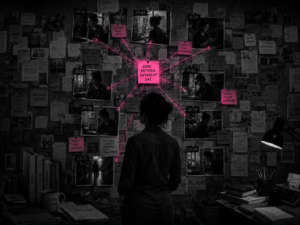
There’s no shortage of insight. Most of it has already appeared in some form, more than once, and usually at the point where something felt slightly off but was explained away. It isn’t that the signal was unclear. It’s that it wasn’t held in place long enough to be noticed seriously.
Looking away happens in small adjustments; in the quiet decision to give something the benefit of the doubt one more time. Individually, each instance feels minor or reasonable, but over time it keeps the overall pattern just out of reach, never quite solid enough to act on.
Nothing new needs to be introduced to change that. No additional framework, no sudden breakthrough, no better explanation. What changes things is the decision to look at what is already there without editing it, without spacing it out, and without turning it into something easier to accept.
Because once it is fully seen, it becomes very difficult to pretend it isn’t there. Most of the time, you already know. You just haven’t been willing to let it stay known. Repeating patterns in your life become easier to interrupt once you stop treating each recurrence as new information.
If you want somewhere to actually do something with what you’re noticing, REVEAL gives you a way to document it properly and see what’s been repeating without interruption.