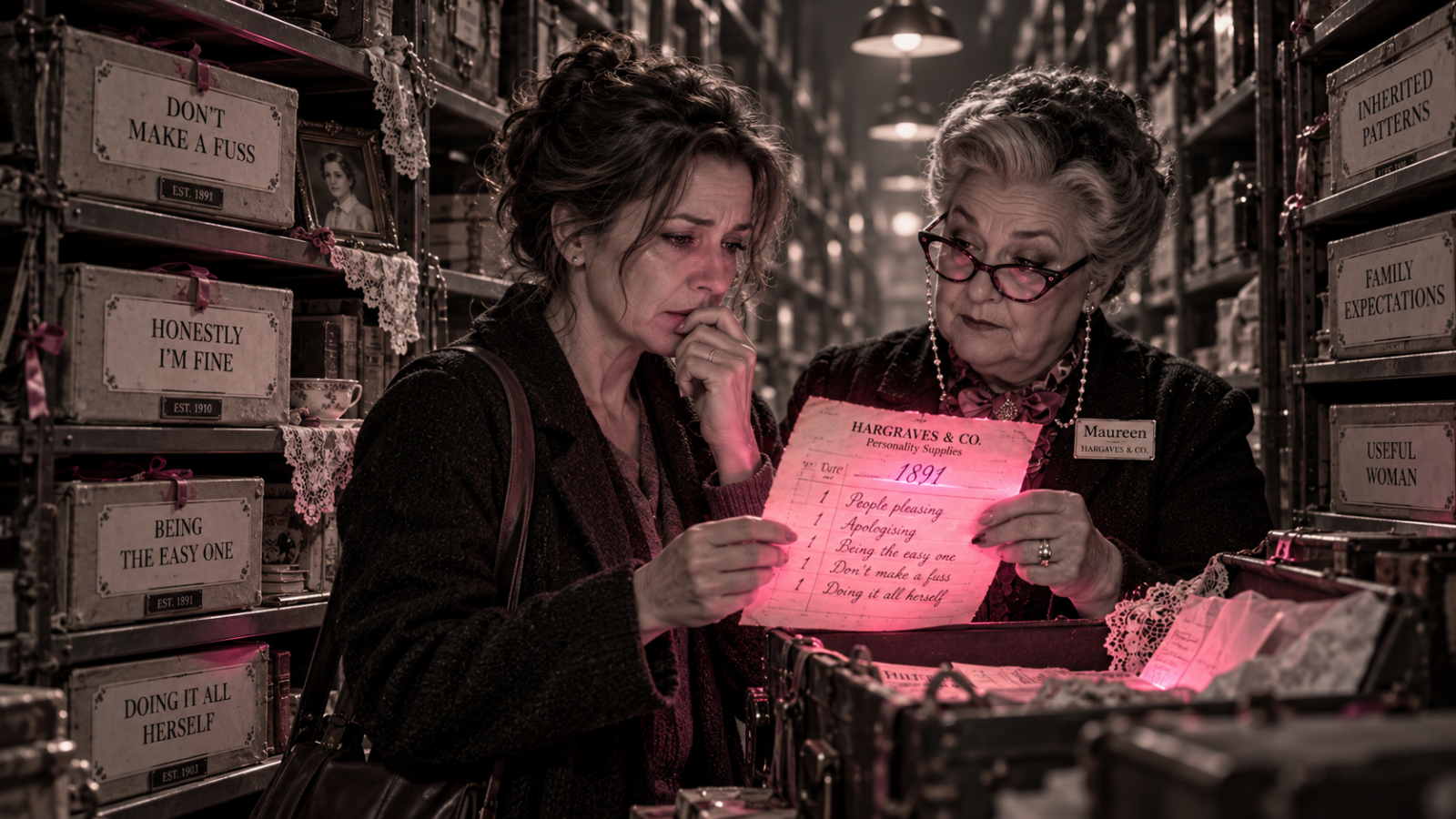
There’s a department store at the back of most women’s minds, and if you take the escalator past Haberdashery and the café that only serves scones with ambition issues, you’ll find the returns desk. You’ll know it’s the right one because the queue is made up entirely of women holding things they never chose, and every single one of them is letting the woman behind her go first, which is why the queue has been moving backwards since 1974.
I joined it on a wet Wednesday, holding my habit of apologising when other people walk into me. I’d owned it for as long as I could remember and it hadn’t ever fitted. It pinched in meetings, rode up at family dinners, and once in a car park, it made me say sorry to a bollard. Which didn’t apologise back, and therefore became the most emotionally boundaried thing in my life that year. I’d decided that I wanted my money back.
The Queue
The woman ahead of me was returning her compulsion to do the washing up at other people’s parties. She explained, to nobody in particular, that she’d once been found at eleven o’clock at night scrubbing a roasting tin she hadn’t used, in a kitchen that wasn’t hers, at a party that was being thrown for her birthday, while her own cake sat uncut in the next room because nobody wanted to start without her and she couldn’t stop until the tin was done.
She told it with the bright, slightly frantic cheer of someone who’s dined out on a story for years and has only just noticed it isn’t funny. She laughed anyway, because it’s a bit funny. But that’s the whole problem.
Behind me was a woman holding being the easy one, still in its original packaging because she’d never been allowed to take it out. Behind her stood a woman returning the phrase “honestly, I’m fine,” which she’d bought in bulk around 1998, and was still working through. Behind her, a single mother held up a sash reading “Doing It All Herself“, which she’d been awarded at school, in supermarket queues, and by an aunt at a christening. Always by people who called her amazing and then left her to it. Admiration, she told me, is a lovely currency to be paid in, until you try to spend it on childcare.
Nobody complained about the wait. Someone passed round a tin of travel sweets. A woman near the front had brought a flask and was topping everybody up, while her own tea went cold. I watched her do it and thought, with real affection, that this was the least efficient building I’d ever stood in, and also, the most familiar.
Maureen
The clerk at the desk was called Maureen. Her badge said Maureen, Returns. Underneath, in smaller letters, Since Records Began. She wore her reading glasses on a chain and had the calm of a woman who’s seen every possible item come across her counter and has stopped being surprised by any of them.
“Receipt?” she asked. I didn’t have one. Nobody ever does, she said. Not unkindly, mind. She turned to an enormous beige computer, and typed in my name, She squinted, and said the five words nobody at a returns desk ever wants to hear: “This wasn’t bought by you.”
According to the system, my apologising habit had been handed down. I received it from my mother, who received it from hers, and so on. Maureen kept scrolling. Past the sixties, the war, and a long stretch of decades where nobody seemed to have written anything down at all. Then she stopped, tapped the glass with one fingernail, and said, “There. Original owner. Purchased 1891.” I leaned over. The original owner was a woman with seven children, a husband who drank the rent, and a landlord who could put the lot of them on the street with a week’s notice. In the column marked Reason For Purchase someone had written, in faded copperplate, keeps the roof on.
“So I can return it to her?” I asked. Maureen gave me the look that every woman behind a counter has given every customer who’s asked for something lovely and doomed. “I’m afraid the computer says Nan,” she said. Then, because she could see I hadn’t followed, “It isn’t yours to return, love. It was never sold to you. You’ve been carrying it for someone who stopped needing it about a hundred and thirty years ago.”
Store Policy: The Price of People Pleasing
Pinned to the wall behind Maureen was a laminated notice headed Store Policy, so I read it the way you read the small print on a contract you’ve already signed. Apparently, items handed down through families can’t be refunded, because there’s no original receipt and no living purchaser. Items that were once survival equipment can’t be exchanged, only understood. At the bottom, underlined twice, was the clause that explained the entire queue: In this establishment, a customer’s value is calculated according to how useful she is to everybody else, and this valuation is reviewed continuously and without notice.
That clause is the whole building. It’s the reason the woman with the flask pours everyone’s tea before her own, the woman with the roasting tin can’t leave a kitchen while there’s a dirty pan in it, and the reason the single mother keeps being called “amazing” by people who’ve never once offered to have the kids. People pleasing is what we call some of this from the outside. Inside the building, it’s simply how you keep your account in credit.
Worth in this place isn’t something you have, it’s something you earn by the hour, and can lose it overnight. Every pattern in that queue was bought, at some point, by a woman who worked out that being useful, agreeable, capable or easy was the price of being kept. She was clever to buy it, and it was excellent equipment in 1891. The trouble is that it stayed in circulation long after the landlord, the rent and the drinking husband had all gone. It was simply handed on, carefully wrapped, to women who had no idea what it was originally for, and quite reasonably assumed it was their personality.
There’s a loyalty card scheme too. Maureen showed me one. You collect a stamp every time you put yourself last, and when the card is full you receive nothing at all, because the stamps were the reward. There’s no prize desk, and you’ll want to start a new card straight away just to be on the safe side. I’ve never in my life been both so insulted by a piece of cardboard, yet recogniseable in one, so quickly.
The Stockroom
Maureen, who I suspect had been waiting years for someone to ask, took me into the stockroom. It was enormous, and smelled of mothballs and lavender drawer liners. It was shelved not by department, but by family. Every family had its own aisle, and every aisle was full of things that had been passed down so many times the labels had worn off. There was a box marked Don’t Make A Fuss, a coat that had been taken in and let out by four generations of women and still fitted nobody. Even a teapot that no one had used since the Coronation, but everybody was too frightened to throw away because Auntie would know.
“People think the stories are the stock,” Maureen said, waving back towards the shop floor, where women could be heard telling others things like I’ve always been the sensible one, or it’s easier if I do it myself. “They’re not. They’re the window display. This, as she patted a shelf so heavy it bowed in the middle, “is the stock; the stories are what we tell people when they ask why we are the way we are. The patterns are what’s actually sitting in the back, deciding what goes in the window, and you can’t see the back room from the shop floor no matter how long you stand there rearranging the mannequins.”
I asked how anyone ever cleared an aisle, and she said most people don’t; they inherit it, add a few bits of their own and pass it on, the way you’d hand down a hostess trolley. The ones who do clear it, she said, never start by throwing things out. They start by finding out what each thing was originally for, because once you know that the apology kept a roof on, and the washing up kept a mother in law onside, you stop treating the thing as a flaw in your character and start treating it as an heirloom you’re allowed to put down.
Following the receipt: past lives as a way into your patterns
The trouble is that the receipt is never in your name. Most of the patterns we carry were bought before we were born, by women we never met, in circumstances nobody told us about. Yet, the usual way of looking at ourselves starts at our own birth certificate and works forwards.
We go to the stories we know: the childhood, the school report that said bright but chatty, the first boss, the first heartbreak. Those stories are real, but they’re the window display again, and if the original purchase was made in 1891, starting your search in the year you were born is like trying to find the beginning of a ball of wool by tugging at the end you happen to be holding.
Which is where the idea of past lives becomes unexpectedly useful, even for the woman in the queue who rolls her eyes at anything involving incense. Family history can tell us something about the women who came before us, but even the most carefully researched family tree has its limits.
It can tell us where someone lived, whom they married and occasionally what they endured. But it can’t tell us is what those circumstances felt like from the inside, what women learnt to do to survive them, or how that lesson might have travelled through a family long after anybody remembered why it began. And sometimes, the stories we already know about ourselves are so convincing that we keep rearranging the same window display.
The idea of a past life offers a different way in. It isn’t proof that you once lived in another century, or that every difficulty can be traced to an ancestor. It’s an imaginative way of stepping outside the biography you’ve spent your life assembling. What if you approached a familiar pattern as though it belonged to someone else? What might you notice about the circumstances that made it necessary, the purpose it once served or the reason you’ve continued carrying it long after that purpose disappeared?
You don’t have to believe you’ve lived before for the question to do its work, any more than you have to believe in Maureen. You only have to be curious about what becomes visible when you stop assuming the story you know is the only story worth examining. Once you’re standing outside your own story, the stockroom suddenly has a door.
That’s what Threadfinders was built for. It’s a guided exploration that uses imagined past lives as a way into the patterns beneath your stories. Rather than telling you who you supposedly were, it invites you to consider the roles you recognise, the behaviours you repeat and the circumstances in which they might once have made sense. Because frankly Maureen hasn’t got the staffing to investigate your previous incarnations, and neither has anybody else. What Threadfinders is interested in, is what you’re still carrying, where it might have come from, and what it was once for, so that you can decide, without anybody’s permission, whether it stays on the shelf.
If you’d like a look at what’s sitting in your own aisle, you can try a free Threadfinders reading online. Choose a card, follow the story it opens and see what feels unexpectedly familiar. It won’t ask you for a receipt or make you queue, and it certainly won’t tell you that you’re amazing and then leave you to it. It’ll simply put a thread in your hand and let you see where it goes.
Back at the Desk
I didn’t get my refund. Maureen was very kind about it. She stamped my apologising habit Not For Resale, which she said was the best she could do. Then she leaned across the counter and told me, quietly, the thing she apparently tells everyone who makes it as far as the stockroom: that you can’t return what was handed to you, but nobody can make you keep carrying it up to the counter either.
I walked back past the queue. The woman with the flask was still pouring. The woman with the roasting tin had found another. On my way out I clipped a display of scented candles with my elbow, and I opened my mouth, and out came sorry, out of habit, out of a woman I never met who had seven children and a week’s notice. I stood there for a moment and thought about her, and I thanked her, silently, for keeping the roof on, and then I told the candles that actually they’d walked into me.
NyxDrop: The receipt was never in your name, which means the debt isn’t either.