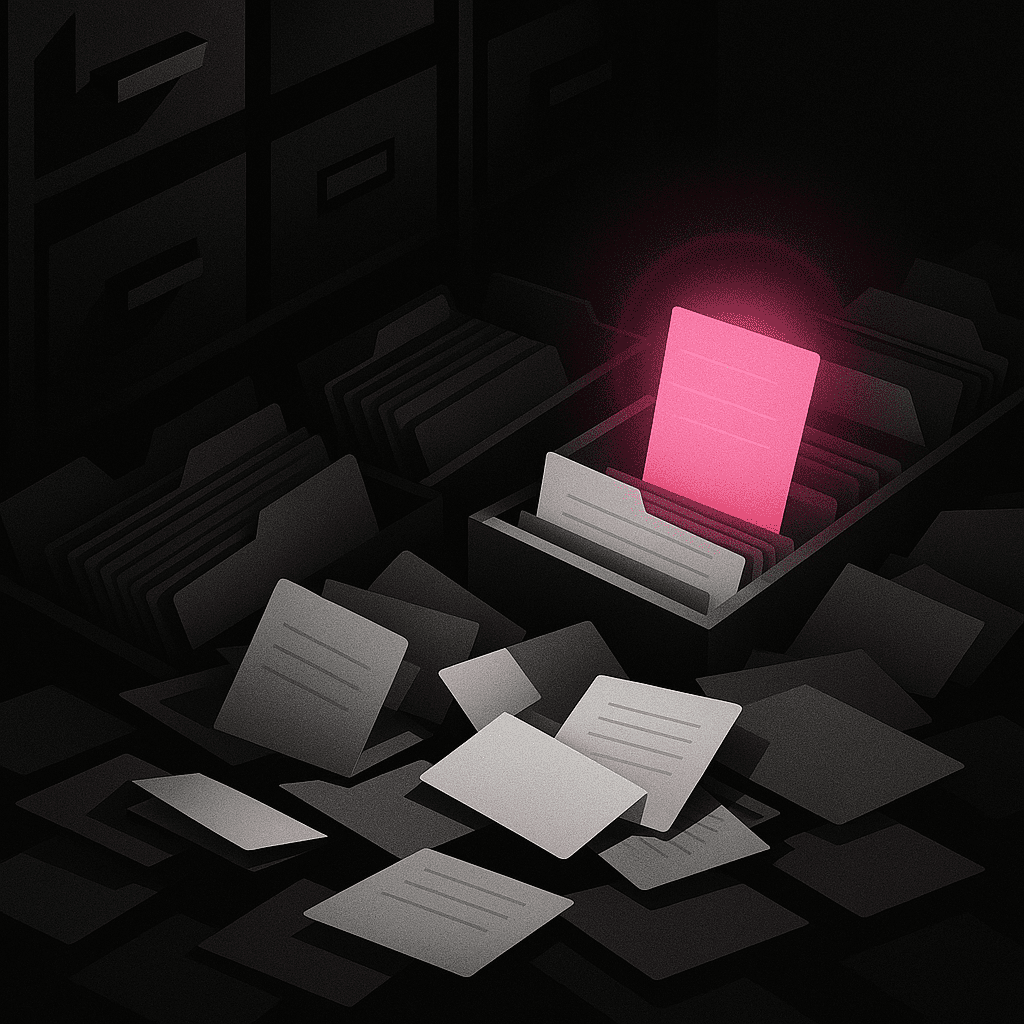
Somewhere in the back of your mind, past the shopping lists and late-night catastrophising, sits a library. Not sleek or digital, or anything you’d show off. This one smells faintly of damp carpet and long-forgotten boiled sweets. Think less Google Drive, more school library where half the covers have bite marks and the Dewey system is just ‘shove it anywhere and hope.’ Its filing system? Index cards. Crooked, tea-stained, biro-scrawled, the sort every school library in the eighties seemed to run on. That’s how your subconscious patterns get stored: messy, outdated, and far too influential for their own good.
The Librarian who presides over this has been working since you were barely tall enough to reach the bottom shelf. They’ve filed every moment, every sharp word, every humiliation or triumph. But because the system never got updated, a minor slight like “mum being late once” ended up on the same shelf as “people always abandon me.” And you wonder why those survival scripts still check themselves out?
The Librarian takes the job seriously. A slammed door? Labelled Horror. A missed text? Straight into Tragedy, cross-referenced with Proof You’re Unlovable. That one stupid thing you said in Year Six is still tagged as Humour, though you’ve never been able to laugh about it. The catalogue isn’t neutral: it shapes your narrative identity and steers the stories you tell about yourself long after you thought you had outgrown them. Every label affixed is more than memory-keeping, it’s metaphor, a shorthand that decides meaning before you even know it.
And here’s the deal: until you see the index cards for what they are, you’ll keep living as if they’re gospel. You’ll continue browsing the same shelves, mistake borrowed scripts for truth and replay outdated genres as if they’re fresh releases. You’re not just the reader in this story. You’re supposed to be the Librarian. But no one ever told you the system was yours to change.
1. Meeting the Keeper of Your Back Catalogue
Every library has a character, and yours is no different. They stand at the centre of it all, the one who decides which memories get dusted off for another spin and which sit mouldering on the back shelf. They aren’t glamorous or particularly accurate, but they are relentless. Their filing choices have shaped you since before you had the language to argue back.
This Librarian doesn’t judge content but classifies by importance, the smallest things often got top billing. That throwaway comment from a teacher about you being “lazy”? Catalogued as if it were the definitive biography of your character. That time a friend tripped you up on the playground. Filed under “evidence you’ll be left behind” and cross-referenced into half a dozen other drawers. Welcome to your back catalogue: a compilation album where every B-side got promoted to lead.
Because your back catalogue doesn’t just sit there, it quietly builds your narrative identity in the background. Every survival script you live out was once a line scribbled in those margins, stamped as permanent. The Librarian doesn’t ask whether a memory is accurate or even relevant anymore. They just file, cross-reference, and guard it. Which is why you can find yourself reacting to a colleague’s raised eyebrow as though it’s your Year Six teacher all over again. Same catalogue, different track on repeat.
Meeting this keeper isn’t about storming the reference desk and demanding a rewrite. It’s about seeing who has been choosing the playlist and realising how long you’ve been dancing to songs you never actually liked.
2. When the Wrong Stories End Up on the Wrong Shelves
Every library has mistakes, too. Books in the wrong section, index cards pointing you to gardening when you were looking for grief. Memories don’t always end up where they belong, and once they are misfiled the trouble begins. Some stories get stuck in the wrong category altogether. A memory that should have been logged as minor and harmless ends up stamped as comedy, leaving it tinged with humiliation every time it resurfaces.
That misfiling lingers for decades, colouring the way you respond to yourself in the present. Or maybe your first heartbreak ended up cross-referenced with Abandonment Issues and Career Ambition. So performance reviews at work still feel suspiciously like being dumped, and feedback emails arrive with the sting of rejection letters.
It sounds absurd, but the brain loves a shortcut. So the Librarian obliges by stitching together connections that made sense to your younger self. But often, these seams don’t hold water today. A slammed door in the present can reverberate with the sound of one from childhood. Or a slow reply to a DM becomes a symbol of being left behind, even when it’s not a reality. The danger of living inside metaphor is that the story feels larger than the moment itself. These are survival scripts, stubborn volumes that keep turning up in the wrong places, convincing you the story is happening all over again.
And one misfiled memory rarely sits alone. The Librarian is thorough in their chaos, cross-referencing until one childhood slight balloons into an entire section on rejection. Before long, the catalogue looks more like a conspiracy board strung together with red thread. Before long, the catalogue looks more like a conspiracy board strung together with red thread. The problem isn’t the memory itself. It’s that your brain filed a postcard under epic novel and won’t stop pushing it like a bestseller.
Nobody gets a neat filing system. Trauma doesn’t line itself up politely, and memory doesn’t respect genre boundaries. But recognising the mess is the first step. Some of the stories you’re replaying today aren’t fresh at all. They’re simply old titles on the wrong shelves, still being dragged into circulation long after their due date.
3. The Messy Business of Misfiled Memories
Memory rarely behaves itself. Once a story is misfiled, the Librarian rarely lets it sit quietly. It gets cross-referenced into other drawers, stitched together with unrelated incidents, until one slight or awkward moment swells into a pattern that feels inescapable. Some stories that should have been filed under minor embarrassments end up stamped with humiliation instead. Decades later, they still carry an edge they were never meant to hold, colouring how you see yourself today.

Subconscious patterns form when the Librarian stitches together connections that made sense to your once eager-to-please self. A slammed door in the present could reverberate with the sound of one from childhood. A slow reply to a message becomes a symbol of being left behind. These are survival scripts in action, dragging yesterday’s plotlines into today’s chapters.
And once a memory is misfiled, it rarely sits quietly. The Librarian loves a cross-reference, so one playground slight soon balloons into an entire section on rejection. Before long, your back catalogue resembles a conspiracy board, red string zigzagging across the shelves, every arrow pointing towards the same tired conclusion: not safe, not wanted, not enough.
There’s no such thing as a perfect catalogue. But noticing the mess is its own kind of power. You start to see that some of the stories you react to aren’t new at all. They are old titles, misfiled long ago, still being dragged into circulation as if they belonged on today’s shelf.
4. The Past Still Wants Its Books Back
Triggers rarely arrive out of nowhere. They are usually the subconscious equivalent of a stern librarian whispering that a loan is long overdue. You feel the jolt in your body, your chest tightens, and it looks like a reaction in the present. Yet it’s the past, demanding you return something you didn’t borrow in the first place.
A colleague raises an eyebrow and suddenly you’re back in Year Six, sensing a teacher’s disapproval. That raised eyebrow became a symbol for every look of disapproval you’ve ever collected. It’s a moment happening today, but catalogued decades ago, still dressed in metaphor. That’s how survival scripts work: subconscious patterns triggered by the smallest cue, pulling the same dog-eared books off the shelf, as if repetition could finally settle the account.
Hearing these whispers for what they are changes everything. You’re not broken because you’re triggered. You’re actually being summoned by an old story, a misfiled book that’s still stamped as current. Recognising this doesn’t silence it instantly, but it gives perspective. You’re not failing the present. You’re being chased for a loan from the past.
5. Deciding What Still Deserves Shelf Space
Every library needs a clear-out once in a while. Not a bonfire or demolition, just a thoughtful look at what still earns its place and what is gathering dust. Your subconscious archive works the same way. It’s crammed with books you never chose, survival scripts passed as hand-me-downs, and titles that were once useful but no longer deserve front-row space.
Deciding what stays isn’t about erasing the past. It’s about being deliberate. You might move that battered volume titled You Always Fail over to the Resilience section instead, to focus on the journey from disaster to recovery. Or that flimsy pamphlet called No One Likes You might, with a new introduction, reveal itself as a guide to choosing the right peoplein your life. And some texts deserve to be retired altogether. Like the inherited rulebook titled Only Valuable When Overworking. That one can finally be filed under B for Bin. Imagine giving shelf space to a pamphlet that’s been gaslighting you since Year Six. Honestly, bin it. Life’s too short for bad filing.
Your narrative identity isn’t fixed or left to gather moss. It’s a collection under review, and you’ve got editing rights. The shelves were actually always yours to manage. You get to decide the display, the archive, and the trash.
Of course, the original Librarian will fuss. They will argue that the Complete Works of Your Teenage Awkwardness is a classic that must never be removed, an old original you could learn a lot from. But that’s the thing. You haven’t picked it up in years. You can smile at the protest, knowing that the old system kept you safe but you’ll take it from here, thanks.
Clearing shelf space isn’t about forgetting. It’s about recognising what’s outdated, what’s useful, and what deserves to be read differently. That’s transformation in action, a symbolic re-shelving of your narrative identity that decides which stories guide you forward and which ones keep you stuck.
That act itself is a transformation: a symbolic re-shelving that shows you which stories guide you forward and which ones keep you stuck. To do that is to meet the metaphors that have ruled your catalogue for too long, and which symbols are worth keeping as guides instead of chains. When you do, the library shifts and you can begin to see yourself not as a collection of misfiled memories, but as the one who chooses which stories remain in circulation.
Most of us wander our own library for years without ever questioning who built it, or why the same dog-eared titles keep ending up in our hands. We think we’re reacting to today, when half the time it’s yesterday’s catalogue. Here’s the messy truth about subconscious patterns: they don’t care about chronology, only survival.
But survival scripts aren’t the whole story. They are just the biggest, loudest books, the ones the Librarian keeps pushing forward because they were stamped “important” way back when. Once you start noticing them, you see the “not good enough” series as overexposed. Or the “always abandoned” trilogy? Tired. Sure, the past will always whisper and call its books back. But you get to decide which ones are renewed and which ones are taken out of circulation. That’s transformation in action: not deleting your past but choosing how it’s shelved.
If this made you curious about the language your subconscious speaks, start with REVEAL and follow the thread.
NyxDrop™: The Librarian can cling to the index cards all they like. You’re the one who decides which stories still deserve shelf space.